No Invoice, No Tax: Gujarat High Court Quashes Rs. 43 Crore GST Demand on Head Office–Branch Cross-Charging in the Amul Case
Distinct persons, ‘Nil’ valuation under Rule 28 and the limits of Section 74 of the CGST Act
Few GST issues have produced as many show-cause notices, with as little guidance from the statute itself, as cross-charging. The CGST Act does not even use the word. Yet since 2017, businesses with offices in more than one State have been told that their head office “supplies” services to its own branches, and that the cost of head office salaries, ERP licences and advertising must be split up, invoiced and taxed.
On 14 October 2026, a Division Bench of the Gujarat High Court gave one of the clearest answers on the point so far. In the case of the Gujarat Co-operative Milk Marketing Federation, popularly known as Amul, the Court set aside an IGST demand of Rs. 43,43,12,441 for July 2017 to March 2019. It accepted that the head office and the out-of-State branches are distinct persons. But since no invoices had been raised, the value of the services was ‘Nil’ under the CBIC’s own circulars, and there was nothing left to tax. The Court also held that the extended limitation period under Section 74 cannot be invoked merely because the facts surfaced in a DGGI investigation.
| Case | M/s Gujarat Co-operative Milk Marketing Federation Limited v. Union of India & Ors. |
| Case number | R/Special Civil Application No. 7085 of 2025 |
| Neutral citation | 2026:GUJHC:64765-DB |
| Court and Bench | High Court of Gujarat at Ahmedabad; Justice A.S. Supehia and Justice Vaibhavi D. Nanavati (judgment authored by Justice A.S. Supehia) |
| Reserved / Pronounced | 08.10.2026 / 14.10.2026 |
| Order challenged | Order-in-Original No. 74/CGST/(Ahmedabad South)/ADC/PBM/24-25 dated 01.01.2025 |
| Demand | IGST of Rs. 43,43,12,441 with interest and penalty under Section 74, CGST Act (July 2017 to March 2019) |
| Outcome | Writ petition allowed; Order-in-Original quashed; Rule made absolute |
Key Takeaways
- Distinct persons: A head office and branches holding separate GST registrations are distinct persons under Section 25(4) and (5) of the CGST Act, and services between them are a supply under Entry 2 of Schedule I, even without consideration.
- No invoice, Nil value: Where no tax invoice is issued by the head office, the value of the service is deemed ‘Nil’ under the second proviso to Rule 28 of the CGST Rules, read with CBIC Circular Nos. 199/11/2023-GST and 210/4/2024-GST.
- No turnover-based apportionment: The Department cannot create a taxable value by apportioning head office expenses in proportion to branch turnover simply because the taxpayer did not cross-charge.
- Section 74 needs foundational facts: Following Tata Steel Ltd. v. Union of India, fraud, wilful misstatement or suppression must be shown in the notice itself. A DGGI investigation, by itself, is not enough.
- Revenue neutrality counts: Where any tax paid would have been available as ITC to the branches, and the expenses were fully recorded in the books, a failure to cross-charge does not by itself point to an intent to evade.
Background: What the Department Alleged
The Federation has its Head Office at Anand, from where all its corporate activities are run. It holds an Input Service Distributor registration for the Head Office and a common registration for its branches and depots in Gujarat. Outside the State, its branches hold separate GST registrations.
The Head Office incurs the usual corporate costs: advertisement and publicity, IT infrastructure, IBM and SAP annual maintenance, audit charges, legal and litigation expenses, and the salaries of its employees. These benefit the branches as much as the Head Office. Between July 2017 and March 2019, the Federation did not allocate these costs to its branches by way of cross-charging. It was never in dispute, however, that every rupee of this expenditure was recorded in the books of account, ledgers and balance sheets kept at Anand.
After an inquiry, the Department issued a show-cause-cum-demand notice dated 31.08.2022 under Section 74. Its case was that the branches were distinct persons under Section 25(4), that the Head Office had supplied services to them, and that GST was payable on the common expenditure and on Head Office salaries, apportioned according to branch turnover. The Federation replied on 13.09.2022.
While the matter was pending, the CBIC issued Circular No. 199/11/2023-GST dated 17.07.2023 and Circular No. 210/4/2024-GST dated 26.06.2024, both dealing with the valuation of services between offices of the same organisation. The Federation placed both before the adjudicating authority. Even so, the Additional Commissioner of CGST, Ahmedabad South, confirmed the full IGST demand of Rs. 43,43,12,441 with interest and penalty by Order-in-Original dated 01.01.2025. The Federation then filed a writ petition seeking certiorari.
Arguments Before the High Court
The Federation’s case
Mr. Paresh M. Dave, with Mr. Amal Paresh Dave, opened with the Delhi High Court’s decision in //M/s Metal One Corporation India Pvt. Ltd. v. Union of India//, 2024 (10) TMI 1534, where show-cause notices on identical facts had been quashed in light of the same two circulars. Since no invoices had been raised, the value of the services was ‘Nil’ and so was the tax.
Counsel also argued that cross-charging is an accounting tool used to measure the performance of profit centres, not a statutory obligation. If the Department’s theory was that the Head Office had supplied services, the demand should have been raised against the Head Office, not the Ahmedabad branch treated as the principal place of business. The reverse charge mechanism had no application, and the demand had not been confirmed under it either. Finally, there could be no suppression when every item of expenditure sat in the Federation’s own books.
The Revenue’s case
Ms. Hetvi H. Sancheti, Senior Standing Counsel, urged the Court not to entertain the petition at all. Her case was that the Federation had deliberately avoided cross-charging to evade tax, and that it had effectively conceded the legal position by starting to allocate expenses and pay tax on them from 01.04.2019.
On the circulars, the Revenue relied on paragraph 20 of the impugned order, which held that the clarification applies only where the recipient branch is eligible for full ITC, and argued that Metal One was distinguishable. It pointed out that the Federation did hold separate registrations for its branches outside Gujarat, and that the valuation had been done under Rules 28, 30 and 31. It also alleged that the Federation had kept the entire ITC at the Head Office instead of passing it to the branches, because the tax burden at the Head Office level would otherwise have been higher. Since the Department was never told that IGST was not being paid on a cross-charge basis, the extended period was said to be justified.
What the Court Decided
1. The branches are distinct persons, but that is only the starting point:- The Court did not accept the Federation’s argument that Section 25(4) was misapplied. It held that the Federation and its branches and depots holding different GST registrations across India fall within the meaning of “distinct persons” under Section 25(4) and (5). Read with Entry 2 of Schedule I and Rule 28, services shared between them are a supply even without consideration. The Act does not define cross-charge, but invoicing these supplies between the head office and branches is what the mechanism amounts to. Where a head office and its branches operate under a single registration, they are not distinct persons and cross-charging does not arise.
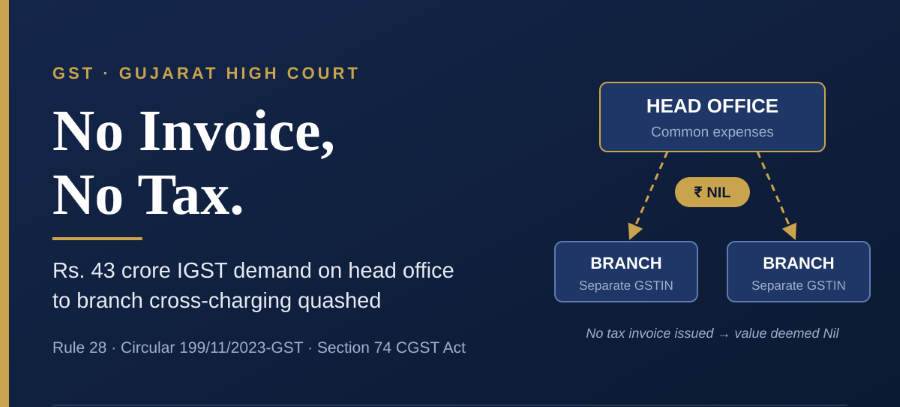
2. No invoice means a Nil value:- This was the decisive finding. Circular No. 199/11/2023-GST clarifies that where the recipient branch is eligible for full ITC, the value declared in the head office’s invoice is deemed to be the open market value. It also clarifies that if no invoice has been issued for a particular service, its value may be deemed ‘Nil’ under the second proviso to Rule 28. Circular No. 210/4/2024-GST says the same.
Since it was undisputed that the Head Office had issued no tax invoices to its branches, the Court held, following Metal One, that the value of the services was ‘Nil’ and no tax liability arose. The adjudicating authority had referred to the circulars only in passing and set them aside with the remark that the taxpayer had not shown that 100% ITC on an invoice was meant for a single branch. The Court called this a non-application of mind. It also held that the Department cannot determine value on a proportionate basis merely because the taxpayer did not adopt cross-charging. And it observed that the services of the Head Office are input services for the branches, with credit admissible under Section 16(1).
3. A DGGI investigation is not proof of suppression:- The extended five-year period had been invoked on one basis alone: that the facts would not have come to light without the DGGI investigation. Beyond that, neither the notice nor the order recorded anything to show fraud, wilful misstatement or suppression.Relying on the Supreme Court’s recent ruling in Tata Steel Ltd. v. Union of India, 2026 (189) taxmann.com 520 (SC), the Bench reiterated that a Section 74 notice requires the officer’s satisfaction that one of these vices caused the short payment of tax. The foundational facts must appear in the notice itself, and the statutory words cannot be recited mechanically to escape normal limitation. In the Court’s words, the “mere exhuming of information by DGGI” without forming an opinion on the core vices cannot attract Section 74.
4. Revenue neutrality and awareness of the Department:- The Court added that even if the Federation had cross-charged, the tax could have been paid using the ITC of the tax paid to the actual service providers, and the same tax would then have been available as credit to the branches. The exercise would have been revenue-neutral. The jurisdictional authorities also knew how the Federation functioned, since the expenses were all recorded in its books at Anand. A failure to cross-charge internally generated services could not, by itself, lead to a finding of wilful evasion.
Holding that the essential ingredients of Section 74 had not been established, the Court allowed the petition, quashed the Order-in-Original dated 01.01.2025 and made the Rule absolute.
Our Take: What the Judgment Does and Does Not Settle
This is a welcome ruling, and on facts like these it is hard to see how the demand could have survived. A few points are still worth keeping in mind before treating it as a complete answer to every cross-charging notice.
First, the Federation won on valuation, not on the “no supply” argument. The Court accepted that services between differently registered establishments are a taxable supply. A business that does raise invoices must still value them under Rule 28, and the Nil-value route is only available where no invoice was issued.
Second, the circulars tie the Nil-value deeming to the recipient being eligible for full ITC. Here the Court faulted the adjudicating authority for brushing the circulars aside, rather than recording a branch-by-branch finding on ITC eligibility. Where branches make exempt supplies or are otherwise restricted in claiming credit, we expect the Department to press this condition harder, and taxpayers should be ready with the numbers.
Third, the Revenue’s argument that the Federation began cross-charging from April 2019 did not carry the day. In our view, rightly so: a change in accounting practice going forward is not an admission of fraud or suppression for the earlier period.
Finally, the Revenue had asked the Court not to entertain the writ. The Bench went into the merits and quashed the order outright, without sending the matter back. Where an order ignores binding CBIC circulars and invokes Section 74 without any foundational facts, the writ route remains a realistic option.
Practical Checklist for Multi-Branch Businesses
- Map your registrations. Only establishments with separate GST registrations are distinct persons. Establishments under one registration are outside the cross-charging debate altogether.
- Document ITC eligibility. Keep records showing that recipient branches are eligible for full ITC, since the Nil-value clarification depends on it.
- Be consistent on invoicing. If you raise invoices for some Head Office services, be clear on how they are valued under Rule 28 and the circulars, and why other services are not invoiced.
- Read every Section 74 notice closely. Check whether it sets out actual facts showing fraud, wilful misstatement or suppression, or merely relies on an investigation and repeats the statutory language.
- Choose the remedy carefully. Weigh the statutory appeal against a writ petition, particularly where the order overlooks binding circulars or the limitation point is strong.
Frequently Asked Questions
Is cross-charging mandatory under GST?
The CGST Act does not use the term. Services between a head office and branches holding separate registrations are treated as a supply under Entry 2 of Schedule I. However, under Circular No. 199/11/2023-GST and this judgment, where the recipient branch is eligible for full ITC and no invoice is issued, the value is deemed ‘Nil’, so no tax is payable.
Does cross-charging apply when the head office and branches share one GST registration?
No. The Gujarat High Court held that establishments under a single registration are not distinct persons, so cross-charging does not arise.
Can the GST department apportion head office costs on the basis of branch turnover?
Not merely because the taxpayer did not cross-charge. The Court held that the authorities cannot determine value on a proportionate basis in such a case.
Are head office salaries taxable when services are cross-charged?
Circular No. 199/11/2023-GST clarifies that where the branch is eligible for full ITC, the value declared in the invoice is deemed to be the open market value, whether or not employee cost is included in it.
Can Section 74 be invoked because DGGI uncovered the issue?
No. Following Tata Steel, the notice itself must set out the foundational facts showing fraud, wilful misstatement or suppression. An investigation alone does not satisfy Section 74.
Conclusion
The Amul ruling gives multi-branch businesses something they have long needed: a clear statement from a High Court, consistent with Metal One, that the Department cannot manufacture a taxable value where none was invoiced and the CBIC itself treats it as Nil. Just as importantly, it reminds adjudicating authorities that Section 74 is not a routine route to a five-year look-back. The facts that made this case strong were simple ones: no invoices, full disclosure in the books and a revenue-neutral outcome. Businesses that can show the same three things will find this judgment very useful.