Is Vaping Illegal in India? The Real Truth About Possession, Public Use & Instagram Sellers
Here's the thing nobody tells you at the vape stall behind your college gate: what you're holding isn't a grey area, a “low-key legal” loophole, or a harmless flex for the 'gram. It's a criminal offence. Full stop. And yet, e-cigarettes are everywhere in dorm rooms, house parties, even IPL dressing rooms. So what's actually going on? Let's break it down like it actually matters, because it does.
Wait, Vapes Are Actually Banned? Since When?
Yep. Not “restricted.” Not “age-gated.” Banned. Completely.
It started as an emergency Ordinance on September 18, 2019, pushed through by the Union Cabinet after the health ministry sounded the alarm. Parliament then locked it in as a permanent law — the Prohibition of Electronic Cigarettes Act, 2019 (Act No. 42 of 2019), officially notified on December 5, 2019. So this isn't some obscure rule — it's a full-blown central law that's been on the books for over six years.
Okay But Why Did the Government Actually Ban It?
Not because vapes are “worse” than cigarettes on paper. The real reasons are more specific and honestly, more about you than you'd think:
- Younger generation was the target market: The government's biggest fear wasn't adult smokers switching to vapes — it was teenagers who'd never smoked anything picking up nicotine because a vape looked cute, came in mango flavor, and didn't smell like a cigarette.
- Nobody actually knows the long-term damage: Cigarettes have a century of grim data behind them. Vapes have been mainstream for barely over a decade. India's stance was basically: we're not running that experiment on our own population.
- The “it helps you quit smoking” pitch didn't hold up: The Indian Council of Medical Research (ICMR) reviewed the evidence in May 2019 and recommended a total ban. The WHO doesn't back vapes as a quit-smoking tool either.
- States were already way ahead: Sixteen states and a Union Territory (Delhi, Maharashtra, UP among them) had banned e-cigarettes on their own before the centre stepped in. The national law basically caught up with what half the country had already decided.
Real Talk: Who's Actually Vaping?
India doesn't run a huge yearly youth vaping survey the way the US or UK do, so we're piecing this together from smaller studies — but the pattern is loud and clear:
- The Global Youth Tobacco Survey (2019) found around 27% of boys and 26% of girls aged 13–15 had heard of e-cigarettes, and about 3.4% of boys and 2.1% of girls had actually used one.
- Awareness and use skew heavily male, urban, and more educated, per the 2016–17 Global Adult Tobacco Survey — though back then, national awareness overall was still pretty low.
- Campus-level studies tell a louder story. One survey among college students in Karnataka found 90% awareness, with a real chunk of students admitting to actual use — and almost all of them found out about vaping through friends or social media, not a shop.
Translation: the face of vaping in India isn't a rebellious teenager buying from a shady dealer — it's an urban college student or young professional, roughly late-teens to mid-20s, who got introduced to it by a friend or an Instagram reel. Which, honestly, is exactly the “gateway to nicotine” scenario the government said it was trying to prevent!
What Exactly Is Off-Limits Under PECA 2019?
Under Section 4, nobody — not a company, not a shop, not an individual — can, directly or indirectly:
- Make, import, export, transport, sell, or distribute e-cigarettes (whole devices or even parts like coils, pods, batteries, or e-liquid)
- Advertise them or promote them in any way, on any platform
And under Section 5, straight-up storing a stock of them is banned too.
“It’s nicotine-free, so it doesn’t count”? Nope. The law covers every kind of e-cigarette, ENDS device, heat-not-burn product, and e-hookah — nicotine or not.
So How Banned Is “Banned,” Really?
As banned as it gets, at least on paper. There's no licensed retailer, no legal age to buy one, no regulated version you can walk into a store for — because there is no legal version. Compare that to the UK, where vapes are actually sold, taxed, and even recommended by doctors as a quit-smoking tool. India went the opposite direction entirely.
Here's the plot twist though: the original law doesn't actually spell out that simply having one in your pocket is a crime — it was written to target sellers, manufacturers, and stockists. Then in October 2023, the Health Ministry dropped a clarification saying possession “in any form” also breaks the law. Legal experts are genuinely split on how much that clarification actually holds up versus the original text — which is exactly why enforcement feels so random. One person gets waved through, another gets their vape confiscated on the spot.
And if you're vaping in public, there's a second law that can catch you too — the Cigarettes and Other Tobacco Products Act, 2003 (COTPA) — though its application to vaping is not straightforward.
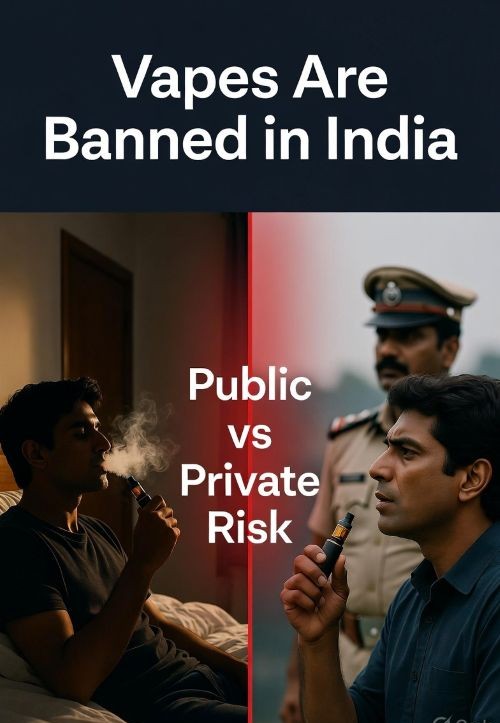
But What If I’m Just Using It — In Public or at Home?
This is the part most articles skip, and it’s where things get confusing for regular people.
PECA 2019 was mainly written to stop the supply chain — manufacturing, importing, selling, distributing, and commercial storage. It does not have a direct section that says “using or carrying an e-cigarette for personal use is an offence.” The 2023 clarification made possession risky, but even that is an interpretation, not a fresh amendment to the law.
Public places (colleges, streets, malls, parks, near schools):
- There is no clear nationwide rule under PECA that specifically bans the act of vaping in public the way some countries do.
- COTPA’s ban on smoking in public places doesn’t cleanly cover vaping either (it was written for traditional tobacco products that are burned).
- In reality, if police catch you vaping in public, they usually act on the possession angle (thanks to the 2023 clarification) or general public nuisance powers.
- Most common outcome for students and young people: Your device gets seized on the spot. Actual fine or court case is less common for first-time personal use. Jail is extremely rare unless you’re also selling or carrying commercial quantities.
High-risk public spots:
- Airports and aircraft — separate strict aviation rules apply. Don’t even think about it.
- Colleges, schools, and educational campuses — many have zero-tolerance policies and will involve security or police.
- Public transport, metros, and government buildings — higher chance of action.
Private places (your room, home, or personal vehicle):
- There is no specific law that bans an adult from vaping inside their own house or car for personal use.
- Section 5 of PECA talks about not allowing a “place” to be used for storage of stock — this is generally understood as commercial quantities, not one device for personal consumption.
- That said, the 2023 clarification still creates some practical risk. If police are searching your place for any other reason, they can seize the vape.
Bottom line:
- Vaping in public = higher chance of losing your device + possible trouble.
- Vaping inside your own home = legally much safer for personal use (though still not officially encouraged).
If It's Banned, Why Does Every Second Person Have One?
This is the part everyone actually wants to know. Here's the honest answer: it's not a mystery, it's just under-policed.
- Instagram and WhatsApp sellers. This is the #1 channel. Easy to set up, easy to vanish and reappear under a new handle if reported.
- Quiet corner shops. Paan shops and small kiosks in less-monitored lanes still stock them under the counter.
- Grey-market imports. Devices slip in through unofficial routes rather than proper customs declarations — much harder to trace or seize.
- The cops have bigger fires to put out. India's law enforcement has far more urgent priorities than chasing down a college student's vape pen, so the actual on-ground risk of getting caught stays low — even though the legal risk on paper is high. Enforcement is stricter against people selling or stocking in bulk than against individuals carrying one device.
Okay, But What Actually Happens If You Get Caught?
This is where people's assumptions are way off. A lot of people treat a vape like a cigarette — a minor thing, maybe a fine at worst. That is not how Indian law sees it when commercial activity is involved.
Here’s what the penalties actually look like under Section 7:
For making, importing, exporting, transporting, selling, distributing, or advertising vapes (Section 4):
- First offence: Up to 1 year in jail, or a fine up to ₹1 lakh, or both
- Second or repeat offence: Up to 3 years in jail and a fine up to ₹5 lakh (both punishment, not either)
For stocking or storing e-cigarettes (Section 5):
- First offence: Up to 6 months in jail, or a fine up to ₹50,000, or both
- Repeat offence: The law does not prescribe a separate enhanced punishment in the same structured way.
A few things people never expect:
- Anyone from a Sub-Inspector of Police upward can search a place suspected of vape activity and seize devices, stock, or records — no extra warrant song-and-dance required under this Act.
- If a company gets caught, it's not just the company that's liable — whoever was running the show at the time can be personally prosecuted too.
- Seized stock doesn't just get handed back once you pay a fine. It goes through a formal disposal process under criminal procedure law.
- For a regular person just carrying one vape for personal use (not selling): The realistic outcome today is usually that your device gets seized. You might get a warning or small fine depending on the officer and situation. Full prosecution leading to jail is uncommon for simple personal possession.
Airport travelers have had vapes confiscated at customs even in tiny, clearly personal-use quantities.
The Bigger Picture
India's take — total prohibition — puts it alongside Brazil, Mexico, and Thailand. Meanwhile the UK, Canada, and the EU went the completely opposite way: regulate it, tax it, and in some cases actively push it as a smoking-cessation tool. Even the WHO sits somewhere in the middle — it won't call vaping a quit-smoking solution, but it hasn't told every country to ban it either, just to keep it away from kids.
So is prohibition the smarter call, or should India be regulating instead of banning outright? That debate isn't settled anywhere in the world.
What is settled is the law as it stands right now: making, selling, advertising, or stocking e-cigarettes in India is a criminal offence with real jail time attached. Thanks to the 2023 clarification, even just carrying one has become a legitimate practical risk — even if the finer legal print on simple personal use is still murkier than most people realize. And if you're doing it in public, especially near colleges, schools, or at airports, the chances of losing your device go up significantly.
Stay informed. The law hasn’t changed in 2026 — enforcement just depends on where you are and what you’re actually doing with it.