Is Rake Legal in India? Where a Poker Club’s Fee Ends and Gambling Begins
Every poker room must earn somehow, and in most of the world the answer is the rake: a small cut from each pot. In India, that single choice can decide whether a club is a lawful recreational business or a “common gaming-house”. This article explains what a rake is, how the Public Gambling Act, 1867 and the Promotion and Regulation of Online Gaming Act, 2025 apply to it, and why paying tax on it does not solve the problem.
What is a rake?
A rake is the house’s share of a game in which players compete against each other rather than against the house. It may be a percentage of each pot, a fixed drop per hand, a time charge that rises with the stakes, a fee carved out of tournament entries, or a jackpot drop.
Operators often rename these as “service charges”, “table fees” or “hospitality”. The label does not matter. What matters is whether the club’s income comes out of, or rises with, the money played for.
What the Public Gambling Act, 1867 says
The 1867 Act, still applied in many States (often with State amendments), turns on a few provisions:
- Section 1 defines a “common gaming-house” as a place where instruments of gaming are kept or used for the profit or gain of the person owning, occupying or keeping it, whether by a charge for the instruments, a charge for the premises, “or otherwise howsoever”.
- Section 3 punishes the owner, occupier or person in charge of a common gaming-house, and anyone who advances money for gaming there; Section 4 punishes persons found gaming in it.
- Section 6 allows cards and gaming tables found during a search to be treated as evidence that the place is a common gaming-house until the contrary is shown.
- Section 12 excludes “any game of mere skill wherever played” from the Act.
Read together, the definition is wide enough to catch almost any charge a club makes; what protects a skill-game club is Section 12, as interpreted by the courts. That exemption is not uniform. Uttar Pradesh has repealed Section 12, and Haryana has replaced the 1867 Act with its own 2025 law.
Where courts draw the line: profit from stakes
In State of Andhra Pradesh v. K. Satyanarayana (1968), the Supreme Court held rummy to be preponderantly a game of skill, but drew a distinction between a club that merely charges for its facilities and one that makes a profit or gain from games played for stakes. A rake is the clearest example of the second: it is taken from the stakes and grows with them.
In May 2026, in State of Tamil Nadu v. Junglee Games India Pvt. Ltd., the Court went further and held that a game of skill played with stakes on the outcome amounts to betting, which States may prohibit. A house that takes a cut of those stakes is, in substance, organising betting for profit.
How different States treat a rake
- Licensed regimes (casinos in Goa and Sikkim, and gaming licences in Meghalaya): a rake can be lawful, because the operator holds a licence for it.
- Haryana: the State’s 2026 framework for skill-game clubs, as reported, bars the operator from taking any rake, commission or share of stakes.
- Uttar Pradesh: with Section 12 repealed and the gaming-house definition built around the occupier’s profit, a rake is especially hard to defend.
- Other skill-exemption States: courts have protected poker clubs on the footing that the club does not profit from stakes; a rake undermines that footing.
- States that prohibit stake play (such as Telangana and Andhra Pradesh): the question does not arise, because stake play itself is barred.
Where the PROG Act, 2025 comes in
The Promotion and Regulation of Online Gaming Act, 2025, in force with its Rules since 1 May 2026, defines an “online money game” as one played on payment of a fee or deposit in the expectation of winnings, irrespective of whether it is a game of skill or chance. For a rake model, three provisions matter:
- Section 5 prohibits offering, aiding or inducing online money games. Any online version of a raked game, whether an app, digital chip wallet or online satellite, falls squarely within it.
- Section 6 prohibits advertising online money games in any medium.
- Section 7 bars banks and payment systems from processing payments for online money games.
Under Section 9, offering is punishable with imprisonment of up to three years, a fine of up to ₹1 crore, or both; advertising with up to two years, ₹50 lakh, or both. The Act does not regulate purely offline play, but an offline club that adds online deposits, wallets or paid online play can move from State law into this Central prohibition.
The GST trap: why paying 40% does not help
Some operators assume they can take a rake and simply pay the higher tax. That misreads both the tax and the law.
- The tax is on the whole stake, not the rake. Since 22 September 2025, betting and gambling are taxed at 40%, and after Gameskraft (2026) the tax falls on the full value of money staked or chips sold. A club earning a small percentage could face tax many times its income.
- Tax is not a licence. GST is levied whether or not an activity is lawful. Registering and paying tax as a supplier of betting or gambling gives no permission under State gambling law, and can itself become evidence against the club.
So how can a lawful club earn?
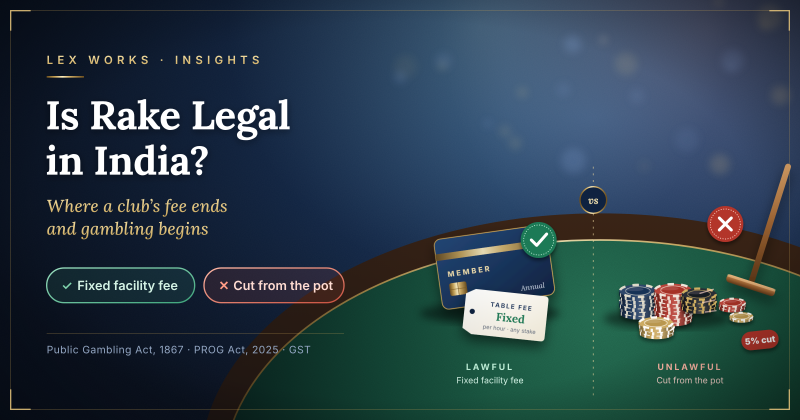
Lawful clubs earn from what they provide, not from what players win or lose: charges that are fixed, payable regardless of the outcome, and unconnected to the money played for. Such facility charges are ordinarily taxed at 18%, with food at 5%. Whether a particular fee, tournament format or membership tier stays on the right side of the line depends on the State, on how it is documented, and on how it actually operates on the floor.
Frequently asked questions
Is a time charge the same as a rake?
Not necessarily. A uniform charge for using a seat or room is different from one that rises with the stakes. Regulators look at substance, not the label.
Can a club pay 40% GST and keep the rake?
No. Paying tax grants no permission under gambling law, and the 40% is charged on the full stakes, not just the club’s cut.
Does the online gaming law apply to an offline poker club?
Not to purely offline play. It applies the moment money games, deposits or payments move online.
Disclaimer: This article is for general information only and reflects the law as on the date of update. It is not legal advice; the position for any specific business depends on its State, premises and operating model.