GST on Offline Poker Clubs After Gameskraft: Facility Fees at 18%, Stakes at 40%, and the Compliance That Holds the Line
On 17 August 2026 the Punjab & Haryana High Court held that a game of skill does not have to wait for a Gazette notification. In September the State notified rummy and poker as games of skill. Operators have read both as a green light. Neither decides how the club’s income is taxed.
GST applies its own test. Less than three months before the High Court’s ruling, in Gameskraft, the Supreme Court held that once money is staked on an uncertain outcome, the activity is betting or gambling for GST, whether the game is one of skill or of chance. For a poker club, the GST question is therefore not whether poker is a game of skill. It is whether the money staked at the table passes through the house.
The two categories in the statute
Under Section 2(52) of the CGST Act, 2017, “goods” include actionable claims. Paragraph 6 of Schedule III takes actionable claims outside GST, except “specified actionable claims”. Section 2(102A), in force from 1 October 2023, defines these as actionable claims involved in, or by way of, betting, casinos, gambling, horse racing, lottery or online money gaming.
A club’s receipts therefore fall into one of two categories:
- Consideration for a service (membership, table hire, private rooms, coaching, food), taxed as a supply of services.
- Money staked on the outcome of play and received by the operator, taxed as a supply of specified actionable claims.
Since 22 September 2025, Notification No. 9/2025-Central Tax (Rate) (Schedule III) has taxed specified actionable claims at 40%. Under the services rate notification, as amended by Notification No. 15/2025-Central Tax (Rate), admission to casinos, race clubs and sporting events such as the IPL is also taxed at 40%.
What Gameskraft decided
On 11 May 2023 the Karnataka High Court had held that rummy, whether online or physical, is a game of skill and that GST was payable only on the platform fee. On 27 May 2026 the Supreme Court reversed that view and revived the department’s show-cause notice. It held that:
- where players stake money on uncertain outcomes, the activity is betting or gambling for GST, whether the underlying game involves skill or chance;
- the operator is the supplier of the actionable claim, not an intermediary collecting a fee;
- tax falls on the full face value of the stake, not on the commission the operator retains; and
- the 2023 amendments to the GST law are valid.
In Junglee Games, decided by the same Bench, the Court held that a game of skill played with stakes on the outcome amounts to betting, and that the protection Entry 34 of List II gives to games of skill does not extend to betting on them. That case arose from State laws on online gaming, but its reasoning is framed in general terms.
For casinos, the value of supply from 1 October 2023 is governed by Rule 31C of the CGST Rules. It is the total amount paid or payable by or on behalf of the player for chips, tokens, coins or tickets, and any amount the casino returns or refunds to the player is not deducted.
What this means for an offline poker club
The deciding fact is whether the house handles stake money.
| Revenue | GST treatment | Rate |
| Annual or day membership | Recreation service (SAC 9996) | 18% |
| Table or private-room hire at a fixed tariff | Recreation service | 18% |
| Coaching and workshops | Commercial training (SAC 999293) | 18% |
| Food and soft drinks | Restaurant service, without input tax credit | 5% |
| Liquor | Outside GST; State VAT | — |
| Chips sold, deposits held, pots settled by the club | Exposed to treatment as a specified actionable claim | 40% on the amount paid |
The arithmetic shows what is at stake. A club that sells chips worth ₹10 lakh in a month faces a 40% exposure on that whole sum, even if its own table income that month is only ₹1 lakh, which would attract ₹18,000 at 18%. Cashing out unused chips does not reduce the taxable amount.
Three structures are likely to be treated as falling on the 40% side:
- a cash cage that sells chips or holds player balances;
- a “service charge” or “time charge” that varies with the pot or the number of hands, which is a rake by another name; and
- tournaments in which entry fees are pooled into the prize. A fixed entry fee with a prize guaranteed by the club from its own funds stands on better footing, but should be tested through an advance ruling.
The Haryana operating guidelines of September 2026, as reported, already bar the operator from taking a rake, a commission or any share of the stakes. They permit charges only for membership, food and table use. The GST position and the gambling-law position therefore point the same way.
The compliance that holds the line
A facility-fee model is defensible only if the club’s records show it. In practice, the club should:
- register for GST in the State before issuing the first invoice, expecting biometric Aadhaar authentication of the promoters and possible physical verification of the premises;
- keep separate invoice series for services (18%), food (5%) and liquor (VAT), and never bundle food into membership;
- reverse common input tax credit under Rule 42 to the extent attributable to the restaurant supply and to liquor, which is a non-GST supply treated as exempt;
- pay GST under reverse charge on legal services from advocates, on security services from agencies that are not body corporates, and on rent for commercial premises paid to an unregistered landlord;
- treat GSTR-1 as the return that fixes liability, because the outward liability auto-filled in GSTR-3B cannot be edited from the July 2025 tax period and returns cannot be filed more than three years after the due date;
- deduct 30% TDS on any tournament prize exceeding ₹10,000 under Section 393(3) of the Income-tax Act, 2025 (formerly Section 194B), and keep a prize register;
- receive fees through banking channels, and never accept ₹2 lakh or more in cash from one person in a day, in one transaction or for one event (Section 186 of the 2025 Act, formerly Section 269ST); and
- seek an advance ruling on the tariff before the first full month of operation.
These obligations are linked. The State guidelines, as reported, make GST and income-tax compliance a condition of the skill-game protection, so a suspended GSTIN can become a gambling-law problem as well. Bank receipts reported to the tax authorities can also be matched against declared GST turnover.
What remains open
Gameskraft settles the position for online gaming, and casino operators were also before the Court. We are not aware of any reported ruling that applies it to a no-rake offline poker room where players settle among themselves. The department may argue that a club which makes its premises available for stake play is the supplier. The operator’s answer is that a supplier must actually receive the stake. Until that argument is tested, a club that never touches stake money has the cleaner position.
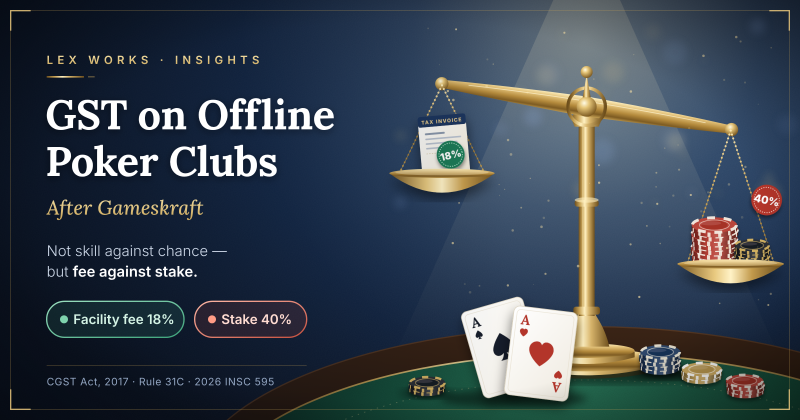
Bottom line: The High Court’s judgment of 17 August and the State notification settle whether a poker room may open. The tax treatment of its income, however, remains a separate question to be answered under the GST law. After Gameskraft, the line is not skill against chance but fee against stake. Charge for the room, the table and the meal. Never take, hold or pay out the money on the table, and keep records that let an officer see that.
Disclaimer: This note is for general information. It is not legal advice on any particular business model, assessment or proceeding.