Bail, Liberty, and UAPA: Supreme Court’s Landmark Ruling in Syed Iftikhar Andrabi v. NIA Reinforces Article 21 Over Stringent Bail Restrictions
The Supreme Court of India delivered a significant judgment on 18 May 2026 in Syed Iftikhar Andrabi v. National Investigation Agency (2026 SCC OnLine SC 881) that strikes a crucial balance between national security concerns under the Unlawful Activities (Prevention) Act, 1967 (UAPA) and the fundamental right to personal liberty under Article 21 of the Constitution.
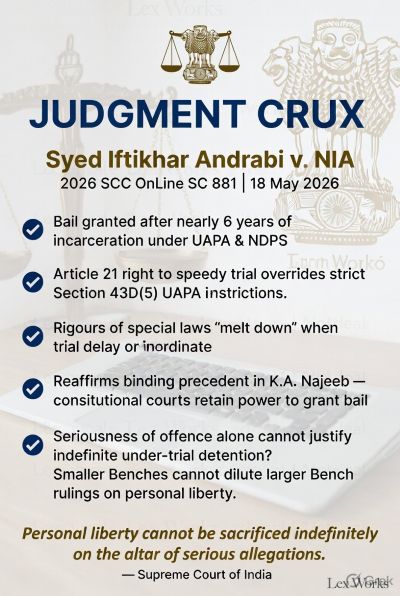
In a detailed ruling authored by Justice Ujjal Bhuyan (with Justice B.V. Nagarathna concurring), the Court granted bail to the appellant after nearly six years of incarceration, underscoring that prolonged under-trial detention cannot become de facto punishment. This decision is set to reshape how courts approach bail applications in UAPA and NDPS cases involving inordinate trial delays.
Background of the Case
Syed Iftikhar Andrabi, a government employee and political activist associated with the Jammu & Kashmir People’s Conference, was arrested in June 2020 in connection with an NIA case involving alleged narco-terror funding. He faced charges under Sections 17, 38, and 40 of the UAPA, along with various provisions of the Narcotic Drugs and Psychotropic Substances Act, 1985 (NDPS Act) and Section 120B IPC.
The prosecution alleged that cash and heroin recovered during investigation were linked to funding terrorist activities, with claims of the appellant’s connections to Pakistan-based operatives. Both the Special NIA Court and the Jammu & Kashmir High Court rejected his bail pleas, citing the seriousness of the offences and the restrictions under Section 43D(5) of the UAPA and Section 37 of the NDPS Act.
By the time the matter reached the Supreme Court, Andrabi had spent over five years and nine months in custody. Charges had been framed, but the trial was moving at a glacial pace—with more than 350 prosecution witnesses still to be examined.
Core Legal Issue: Can Statutory Bail Bars Under UAPA Override Article 21?
The central question was whether the stringent “prima facie true” test under Section 43D(5) of the UAPA completely ousts the constitutional courts’ power to grant bail when an undertrial’s right to speedy trial under Article 21 is violated due to inordinate delay.
Section 43D(5) provides that an accused shall not be released on bail if the court is satisfied that the accusations are prima facie true. Similar restrictive conditions exist under the NDPS Act. The NIA argued that the gravity of the allegations—terrorism financing through narcotics—warranted continued detention.
Supreme Court’s Reasoning: Constitutional Supremacy and the Limits of Statutory Restrictions
The Court firmly held that while special statutes like the UAPA serve vital national security objectives, they cannot be allowed to eclipse the overarching protections of Article 21.
Drawing heavily from the three-Judge Bench decision in Union of India v. K.A. Najeeb (2021), the Court reiterated:
“The rigours of such provisions will melt down where there is no likelihood of trial being completed within a reasonable time and the period of incarceration already undergone has exceeded a substantial part of the prescribed sentence.”
The judgment’s core motive is crystal clear: to prevent the criminal justice system from turning pre-trial detention into an indefinite punitive measure. The Bench observed that laws enacted to combat terrorism and organised crime must not become tools for prolonged incarceration without trial, especially when the State itself cannot ensure speedy adjudication.
Justice Bhuyan went further, delivering a strong message on judicial discipline. The Court criticised smaller Benches for “progressively hollowing out” the constitutional force of larger Bench decisions like K.A. Najeeb without expressly disagreeing with them. It specifically called out the approach in Gurwinder Singh v. State of Punjab, where a two-Judge Bench had sought to distinguish Najeeb and introduced a “twin-prong test” that effectively made bail almost impossible under UAPA once prima facie satisfaction was recorded.
The Supreme Court clarified that Najeeb is not an equitable exception but a binding constitutional limitation on the statutory embargo itself. Zahoor Ahmad Shah Watali (the much-cited 2019 judgment) must be confined to its own facts—where the High Court had conducted a mini-trial at the bail stage—and cannot be used as a blanket justification for denying bail in cases of long incarceration.
Why Bail Was Granted: Application to Facts
Applying these principles, the Court found:
- The appellant had already undergone nearly six years of custody.
- Trial completion was “well nigh impossible” in the near future with over 350 witnesses remaining.
- There was no direct recovery from the appellant; much of the case rested on allegedly inadmissible disclosure statements and police confessions.
- Several co-accused with similar or lesser periods of custody had already been granted bail by the High Court.
- The delay was largely attributable to the prosecution.
The Bench emphasised that the seriousness of the offence, while relevant, cannot justify indefinite detention when speedy trial becomes illusory. Article 21 applies irrespective of the nature of the crime.
Broader Impact on UAPA and Special Laws Bail Jurisprudence
This judgment sends a clear signal to trial courts, High Courts, and investigating agencies:
- Speedy trial is non-negotiable — Courts must factor in the realistic timeline of trial completion while deciding bail.
- Constitutional courts retain inherent powers — Statutory restrictions under UAPA/NDPS do not oust Article 21 relief in cases of prolonged incarceration.
- Judicial discipline matters — Smaller Benches cannot dilute binding larger Bench precedents.
- Practical safeguards — Mere framing of charges or “seriousness” of allegations is no longer an absolute bar to bail when Article 21 is infringed.
Conclusion: A Timely Reminder of Constitutional Balance
The Syed Iftikhar Andrabi judgment is not about weakening anti-terror laws. It is about ensuring that the fight against terrorism does not come at the cost of the very constitutional values the State seeks to protect.
By reaffirming that personal liberty cannot be sacrificed indefinitely on the altar of “serious allegations,” the Supreme Court has reinforced a fundamental principle: an accused remains presumed innocent until proven guilty. When the system fails to deliver speedy justice, continued detention becomes unconstitutional.
This decision will undoubtedly influence thousands of pending UAPA bail applications across the country and serves as an important check against potential overreach in the application of stringent special laws.
The Constitution remains the supreme law—even in the most sensitive cases.